Irrigation Water Quality: Summer Issues and Watch Outs

Irrigation Water Quality: Summer Issues and Watch Outs
Why Irrigation Water Quality Becomes a Summer Issue
Late Australian summers place huge pressure on turf systems. Hot, dry weather pushes bent greens to their limits, while storm activity becomes unreliable, meaning dams and bores aren’t flushed or replenished as often as needed. As water sources shrink, salts and suspended solids concentrate, gradually altering soil chemistry. This article explains why these changes occur, the chemistry behind them, and how turf managers can proactively manage irrigation water to protect plant and soil health.
How Alternate Water Sources Change Over Time
Many facilities rely on a mix of town supply, bores and dams, but when natural rainfall is limited and demand increases, alternative water sources begin to shift in character. Long dry periods cause dams to drop and bores to draw deeper, increasing the concentration of salts, bicarbonates, carbonates, sodium and suspended solids. What starts as a gradual change can quickly accelerate when these sources become the primary water supply. As a result, the soil can accumulate salts and undergo structural changes faster than expected, especially when no natural leaching rainfall occurs.

What Are the Key Things We Are Looking For?
A thorough water analysis remains the best tool for assessing risks and planning corrective actions. Several indicators are particularly important:
-
pH – Not a problem on its own, but a symptom of underlying chemistry. It reflects the presence or absence of bicarbonate, carbonate and certain salts.
-
Electrical Conductivity (EC) – Indicates the total concentration of dissolved salts but doesn’t identify which ones.
-
Sodium Adsorption Ratio (SAR) – Shows the relationship between sodium, calcium and magnesium. Even if all three are high, their ratio determines whether the water is manageable.
-
Adjusted SAR – Adds the effect of carbonate and bicarbonate, providing a clearer picture of whether sodium accumulation or insoluble salt precipitation is likely.
These values become especially meaningful when tracked over time, as many issues develop gradually and only become visible after the soil has already changed significantly.
How Poor Water Quality Impacts Soil and Turf
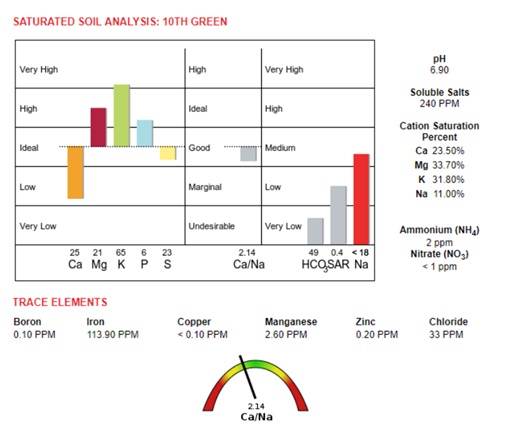
Soil chemistry rarely shifts overnight. Instead, it changes incrementally as irrigation water deposits its chemical signature into the profile. High bicarbonates slowly raise soil pH and lock up nutrients. Excess sodium displaces calcium and magnesium, weakening soil structure, reducing pore space, and decreasing infiltration. Although tolerant turf can mask these changes for a while, once symptoms appear poor root health, water repellency, wilt or patchy decline the structural damage is often already well-established. Understanding this slow, cumulative effect is essential for staying ahead of soil-based decline during summer.
Managing Water and Soil Problems in Challenging Summers
For many turf managers, using alternative water sources isn’t optional so the solution lies in strategic management rather than avoidance. By proactively monitoring water quality, you can identify seasonal shifts early and counteract them through amendments at the source, during application, or via consistent soil conditioning programs. Neutralising bicarbonates, boosting calcium availability, improving infiltration and maintaining a structured amendment regime all help counter the long-term effects of “problem water.” Even heavily mineralised sources can be made manageable when their risks are understood and addressed methodically.
How Nuturf Can Help You
Nuturf provides detailed irrigation water testing, interpretation and ongoing support. Our team helps identify the true risk profile behind pH, EC, SAR and Adjusted SAR, and advises on specific measures needed to make challenging water sources workable. With a wide suite of soil and water amendment products, along with technical expertise and accurate calculation tools, we can help you manage water quality confidently through the most difficult parts of summer protecting both soil structure and turf performance.