How to Plan a Pre-Emergent Herbicide Strategy

How to Plan a Pre-Emergent Herbicide Strategy
Planning a pre-emergent herbicide program for warm-season turf begins with a clear understanding of three factors: the current condition of your turf coming out of winter, how much recovery is needed during spring, and which weeds require control. While it is possible to begin with a basic template, the strategy must always be customised for the site, the seasonal conditions, and any spring renovation activities that will be conducted.
Assessing Turf Condition Before Choosing Chemistry
An honest evaluation of turf condition is essential because the wrong chemistry applied at the wrong time can slow recovery. You must consider whether the turf requires substantial recovery after winter or only light rejuvenation. Determine whether a major renovation will be performed or if a light grooming is all that’s required. Just as importantly, assess whether the root system beneath a thinned surface is strong and deep, or whether it is sparse, shallow and just as in need of rebuilding as the canopy above.
These factors matter because some herbicides interact with roots positioned high in the soil profile. Healthy turf with deep, established roots can tolerate those chemistries well. Turf with weakened or shallow roots, however, may be affected in similar ways to emerging weeds. Understanding root depth and health before selecting a product ensures recovery is not unintentionally delayed.
Understanding Group D Herbicides in Warm-Season Turf
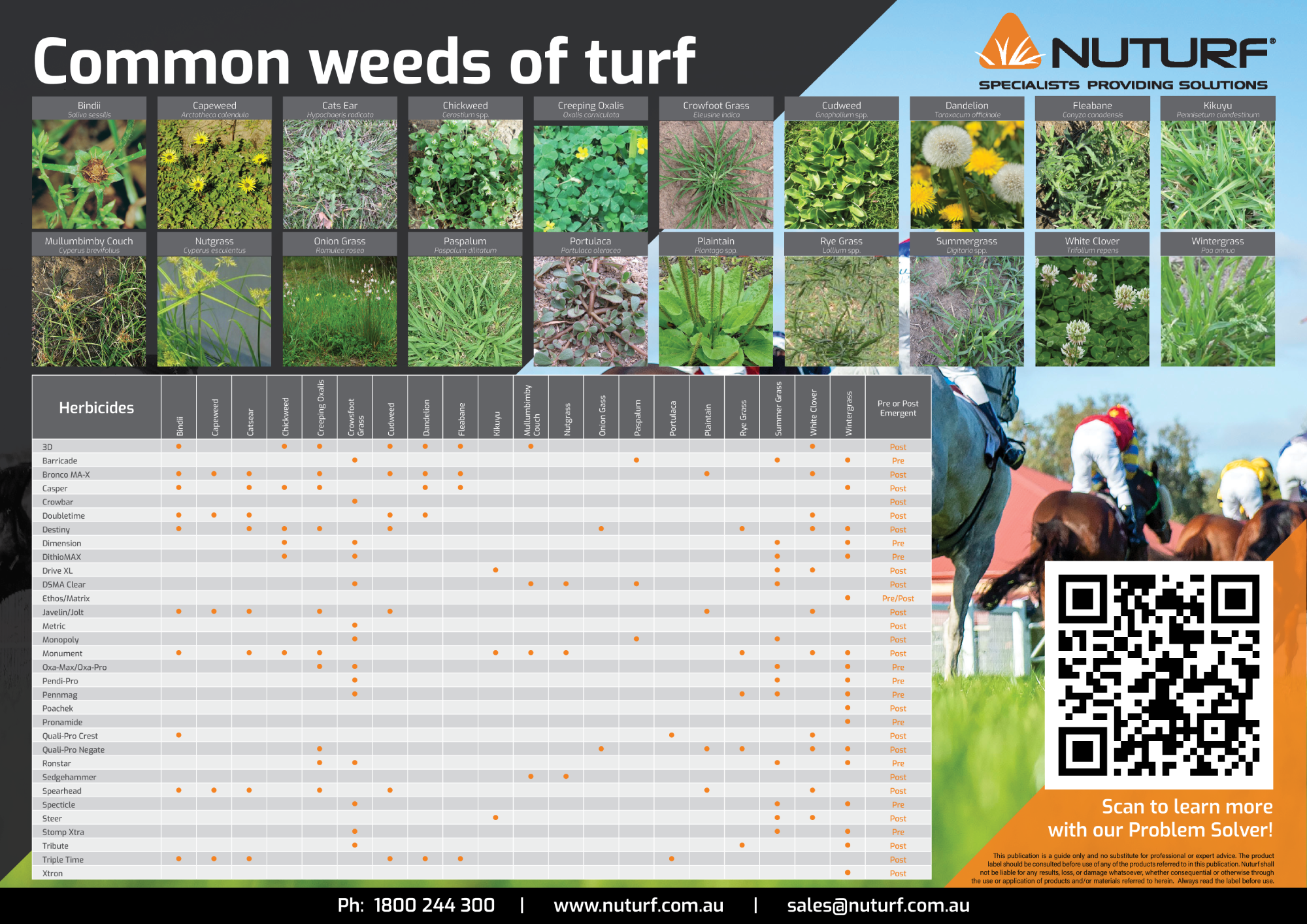
The Group D herbicides are strongly represented in the turf managers tool box for pre-emergent weed management. Products such as prodiamine (Barricade), dithiopyr (Dimension) and oryzalin (Embargo) have long been valued for their reliability and predictable performance. They all create a chemical band high in the soil profile, where they target the developing root tips of germinating weeds. Because their selectivity is based on product placement rather than selective chemistry, turf condition plays a major role in how safely they can be used.
Turf with poor health or shallow, under-developed roots may attempt to grow new feeder roots in the same upper zone where the herbicide band sits, making it more susceptible to injury. In contrast, established turf with strong, deep root systems keeps most of its roots below the band, allowing normal spring rejuvenation with minimal interference.
While Group D products have dominated pre-emergent programs for years, Indaziflam (Specticle) provides an important alternative with a different mode of action (Group O). It inhibits crystalline cellulose deposition, affecting cell wall formation, elongation and division. Because herbicide resistance remains a constant threat, rotating Group D herbicides with Specticle is a smart, modern strategy. Its longevity and biochemical differences make it a genuine rotation partner that fits well into varied scheduling approaches across spring and summer.
Why Indaziflam (Specticle) Is an Important Rotation Partner
Herbicide resistance remains a constant threat, which makes chemical rotation essential. Indaziflam (Specticle), a Group O herbicide, offers a different mode of action from the Group D family. Instead of targeting root tips, it inhibits crystalline cellulose deposition, disrupting the formation and elongation of plant cell walls.
This different biochemical pathway makes Indaziflam an ideal rotation partner. It shares similar results (weed seedling suppression), but through an entirely different mechanism. Its long-lasting performance also makes it valuable in program designs where extended protection is needed.
The Complementary Chemistries That Greatly Assist Sportsfield Recovery
When spring renovations begin, surfaces are often thin, stressed and in need of strong rejuvenation. At the same time, herbicide choices made during this period must protect both recovery and long-term chemistry performance. This is why a complementary, multi-window approach is so effective.
A non–root-pruning option such as S-Metolachlor (Group K) is ideal before renovation, as it targets coleoptiles rather than developing turf roots. This allows weed suppression without interfering with the turf’s ability to re-root, regenerate and stabilise after renovation. Once recovery is underway and the turf has regained density and root depth, a second window opens where longer-residual options—such as Group D herbicides or Indaziflam (Group O) can be safely introduced. At this stage, these chemistries create a strong barrier to weed establishment without restricting new turf growth.
This staged strategy also supports resistance management. Rotating across Groups D, K and O reduces selection pressure on any single chemistry, preserving long-term performance. If extended control is required after the post-renovation window, products like oxadiazon (Group G) provide an additional selective option that controls weeds while maintaining turf growth and resilience.
By matching herbicide behaviour to turf physiology before, during and after renovations, turf managers can achieve faster spring green-up, healthier recovery and a more durable, sustainable chemistry program.
How Nuturf can help you
Nuturf stock a suite of chemistries and brands to cater for all your pre emergent needs and preferences. We stock all the major Group D options and can talk you through the characteristics of each to identify best fit for your site. We offer multiple formulations of Metolachlor and stock the newer option Specticle (Indaziflam). We have group D and G options in granular forms and can also offer combinations that include an NPK fertilizer.
We can sit down with you and match a sequence of product use that suits your site, your needs and your budget.